真善忍国际美展 Art of Truth, Compassion, Tolerance

Showing posts with label Interview with Artist. Show all posts

Thursday, June 29, 2023

[Epoch TV] Pure Beauty: ‘Unmoved’ | NTD International Figure Painting Competition

 Epoch TV

Meet the young Vietnamese artist Loc Duong, who won the Humanity and Culture Award in the NTD International Figure Painting Competition.

His first-ever oil painting “Unmoved” has been very popular and made many people feel at peace.

He decided to take on the challenge of oil painting as he believes in the mission of NTD’s International Figure Painting Competition, that “painting could help to purify people’s minds.”

Join us on this inspiring journey to visit the young artist in Vietnam as he shares his amazing experience while creating “Unmoved.”

WATCH Pure Beauty: Unmoved | NTD International Figure Painting Competition

(https://www.ganjingworld.com/video/1fpm01vdfpd5WqQ8fvE4bJQXp1e01c)

——————————————————————————

We are delighted to present a selection of oil paintings by talented artists from NTD’s International Figure Painting Competition.

The NTD International Figure Painting competition is a groundbreaking effort to pave a path for humankind to return to truly fine art.

Its mission, “Pure Truth, Kindness, and Beauty,” has inspired many artists in creating art that is both profound in content as well as perfect in technique.

​All net proceeds will go toward supporting the artists and the competition.

Award-winning original paintings, canvas wraps, and prints are now available for purchase.

To view more of the art collection, please visit our online art store.

Source: https://www.theepochtimes.com/pure-beauty-unmoved-ntd-international-figure-painting-competition_5179659.html


Editor’s Note: Dear readers, do you know that Falun Dafa, originally from China, is currently practiced by people in over 100 countries? But in China, since Jul. 20, 1999, Falun Gong is defamed, slandered and persecuted due to the Chinese Communist Party’s fear of Falun Gong’s rapidly growing popularity. Jiang Zemin, former head of the Chinese Communist Party (CCP), perceived the spiritual discipline’s growing popularity as a threat to the CCP’s atheistic ideology.

To learn more about the persecution Falun Gong practitioners are subjected to in China, visit http://faluninfo.net/.

For more information about the practice or to download Zhuan Falun, visit: www.falundafa.org. All books, exercise music, resources, and instructions are available completely free of charge.

——————————————————————————

1305121921312100

Why Jiang Zemin and CCP Persecute Falun Gong?

http://thetruthaboutfalungong.blogspot.sg/p/epoch-times-nine-commentaries-on.html

[VIDEO] Why Jiang Zemin and CCP Persecute Falun Gong?

http://thetruthaboutfalungong.blogspot.com/p/video-why-jiang-zemin-ccp-persecute.html

Wednesday, March 8, 2023

[The Epoch Times] Former Atheist Artist Paints Heavenly Realms, Inspires Kindness in Others: ‘Gods and Buddhas Really Do Exist’


‘An artist should be someone who loves to cultivate morality.’

BY EPOCH INSPIRED STAFF 

JANUARY 30, 2023

Once an atheist, a young award-winning artist’s work now revolves around faith: painting the heavenly realms and validating the existence of the divine. His impressive themes contrasting virtue from vice naturally guide viewers toward kindness and forgiveness.

A part of the painting “Tian Guo Marching Band.” The words Tian Guo mean Divine Land in Chinese. (Courtesy of Loc Minh Duong)

Meet Loc Minh Duong, a digital illustrator born and raised in Ho Chi Minh city, Vietnam.

Duong has been drawn to Renaissance artwork, especially paintings, since his school years. Following tradition and upholding truth are the core themes of his work. He believes that true artists are able to inspire in others a longing for pure goodness—and to achieve this, artists are required to be mindful of how their own thoughts impact their art.

“Traditional values are not only reflected in how an artwork appears at the surface but also in the process of creating the work,” he told The Epoch Times.

Loc Minh Duong. (Courtesy of Loc Minh Duong)
“The Way Home”: A section of the painting Duong is currently working on. (Courtesy of Loc Minh Duong)
A Buddha holding a sacred scroll with the Chinese characters 誓約 (shìyuē), meaning “vows” written on it. According to Eastern culture, all beings must aspire to find their life purpose, which is closely tied to the fulfillment of their holy vows they made to the divine before birth. (Courtesy of Loc Minh Duong)
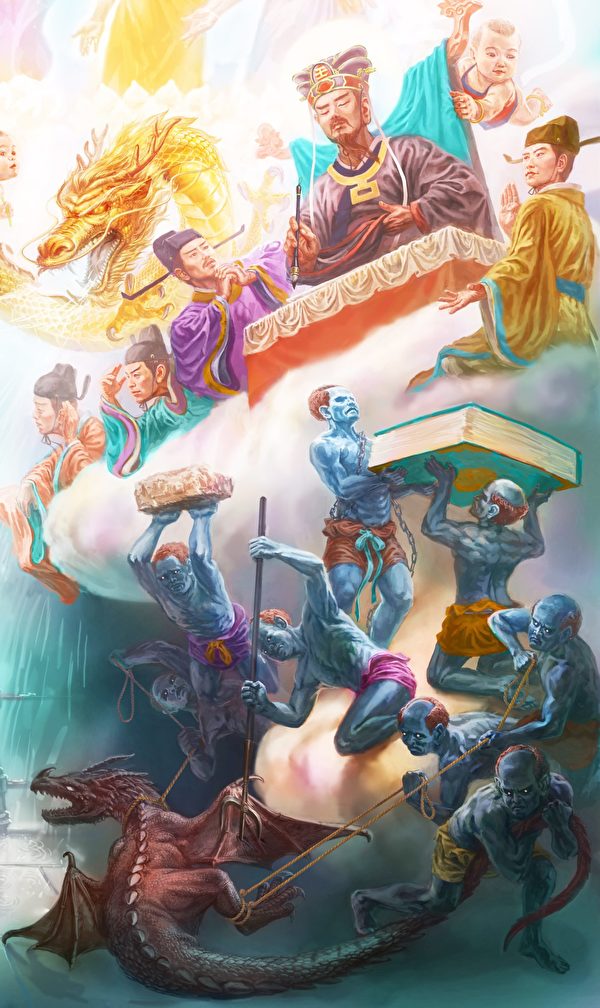
A section of the painting “The Choice of Future”: The King of Hell sits on the cloud confirming judgments based on the accounts and proofs being passed onto him. Seen below is the evil red dragon, which represents communism and its worldwide crimes, and devils are ready to punish it in hell. (Courtesy of Loc Minh Duong)

Duong added: “What do artists think about when they create their work? Do they think about the benefits they gain or think about higher meaningful things? Does the world in their work make viewers feel more peaceful? An artist should be someone who loves to cultivate morality because every thought they think in life can be reflected in the picture, and the viewer can feel their inner worlds.

“Life needs to aim for prosperity and abundance, but the spirit always needs to find its way back to the most basic moral principles. Just like a beautiful painting: the external expression can be very impressive, but the artist’s mind must be calm and empty [of bad thoughts].”

Forging the Path

Duong’s interest in the art world grew in school when he first saw a painting of “The Litta Madonna” by the Renaissance artist Leonardo da Vinci. He was fascinated by the masterpiece.

“In that painting there is something attractive beyond the beauty of reality—a divine reality,” he said. “Since then, I have always admired Renaissance paintings.”

Loc Minh Duong working on a digital painting. (Courtesy of Loc Minh Duong)

In college, Duong chose to study interior design and really enjoyed art classes. Outside the classes, he worked as an assistant to an artist who taught him many things about art. After graduating from university, Duong began his career in digital illustration. He currently works in the advertising field and mostly does digital paintings.

One of his most famous works is the painting titled “Unmoved” which received the “Humanity and Culture” award in the NTD 2019 Oil Painting Competition.

The painting shows a determined little girl sitting still in meditation enveloped in bright golden light. The imminent danger depicted in the form of hungry ferocious wolves has no sway over her. The girl symbolizes the untapped strength and all-harmonizing compassion that shine forth only if the heart is unmoved and the will is resolute as one faces life’s adversities.

“Unmoved”: The painting received the “Humanity and Culture” award in the NTD 2019 Oil Painting competition. (Courtesy of Loc Minh Duong)

Duong said the painting has received positive feedback from viewers across different cultures, with the majority sharing that it gives them a “sense of peace.” Others said that they felt “good energy” emanating from the picture.

“Maybe that is the mission of the painting,” he said.

‘Gods and Buddhas Really Do Exist’

Once a confessed atheist, Duong says he used to be one of the countless who arrogantly believe that Buddha was nothing more than a “wise man who created a philosophy for a happy life.”

One day, as he visited the library of a temple to pick up a movie for a friend, he experienced something that made him question the existence of God.

“When I was looking for the movie in the library, a stack of DVD discs suddenly fell on my head and the laughter of many people rang out, even though there weren’t too many people in the library,” he said. “At that time, a question popped up in my mind: ‘Is God real?’”

A part of the painting “Tian Guo Marching Band.” The words Tian Guo mean Divine Land in Chinese. (Courtesy of Loc Minh Duong)
“Tian Guo Marching Band”: The full painting.

Recalling how the toxic concepts of atheism were washed from his mind, Duong said that some of his friends in Vietnam were once talking about the spiritual practice of Falun Gong (or Falun Dafa), an ancient meditation and self-improvement system rooted in the Buddhist tradition. Ironically, Falun Gong is flourishing in Vietnam—a communist country—while it has faced unprecedented persecution in nearby communist China since 1999.

Out of curiosity, Duong borrowed the book “Zhuan Falun,” the main text of the spiritual practice, from one of his friends to read.

“I found the things written in the book to be very scientific, explaining several spiritual phenomena in a very easy-to-understand way,” he said. “I realized that Gods and Buddhas really do exist, and they exist scientifically and are not created by human imagination.

“I now sincerely respect Gods and Buddhas. I respect them because I know they really exist and always protect people.”

Duong said the principles detailed in the book also answered many of his questions and enabled him to live a virtuous life.

The painting titled “Speechless” depicts a Falun Gong adherent reading the book “Zhuan Falun,” which has been translated into 40+ languages so far. (Courtesy of Loc Minh Duong)

“I had always found human happiness to be limited, and I wonder if there is a kind of eternal happiness,” he said. “After reading Zhuan Falun, I understood that eternal happiness could only be achieved when one aligns with the nature of the universe: Truthfulness, Compassion, Tolerance.

“Falun Gong has given me the confidence that as long as I align my thoughts and actions with ‘Truthfulness, Compassion, Forbearance,’ whatever I am worthy of will come back to me, in different ways. When you see how life works, you will feel happy even in unfavorable circumstances.”

Talking about the ongoing persecution of the faith, Duong said that the persecution of Falun Gong has now extended beyond the borders of China, “becoming a test of conscience for people all over the world.”

“No matter what country, the color of skin, religion you are… it is hard to remain silent before such a crime,” he said.

A painting shows criminal inmates looking in awe at a brutally beaten Falun Gong adherent as she meditates while incarcerated in a Chinese prison for refusing to give up her faith. (Courtesy of Minghui.org)
“See You Up There, Mom”: Based on a real-life incident, the painting shows a mom being tortured for her faith in Falun Gong while the soul of her months-old baby son, who has been killed by the Chinese prison guards, is seen flying above and encouraging her to stay strong. (Courtesy of Loc Minh Duong)
“The Specter of Communism Is Ruling Our World”: Duong made the painting for an event in the Czech Republic to launch the book “How the Specter of Communism Is Ruling Our World.” (Courtesy of The Epoch Times)

Inspiring Morality and Clarity

The wise young man believes holding onto traditions and morals in day-to-day life is the surefire secret to achieving success that is far more enduring and rewarding.

Nurturing essential virtues like thinking of others’ needs first and cultivating a calm and compassionate heart has become the basis of everything Duong does. And he says when the mind is pure, inspiration flows forth effortlessly, like an eternal fountain.

“There are times when I feel I lack the inspiration to draw,” he said. “But I soon realize that I have allowed selfish thoughts to infiltrate the sacred creative process. Thoughts like, ‘I hope my paintings would be praised by others,’ or I’m just afraid that others would criticize my work.

“Joy gained from selfishness is very short-lived. So if you paint with such thoughts, you will soon feel uninspired.

“In modern life, I have found that there are many movies, classes, businesses, and celebrities that teach one a smart way of working for quick success. However, I’ve also seen that the people who are consistently successful are those who pursue certain traditional virtues like patience, honesty, and forgiveness.”

“The Light of Future”: A group of children with a Falun Gong lotus amulet, which has the words “Truth, Compassion, Tolerance Is Good” written on it. (Courtesy of Loc Minh Duong)
Loc Minh Duong practicing the sitting meditation of Falun Gong. (Courtesy of Loc Minh Duong)

As an artist, Duong stresses there is profound significance in honoring morality in the creative world. “A painting should remind people of traditional moral values,” he said, adding that through such paintings people will then “recall their innate kindness and have faith in God.”

Duong has firsthand experience of God-led, inspiring ideas coming his way. He said that whenever he thinks of using paintings as a medium to depict righteous values or the existence of Gods, the ideas spark in his mind and are “waiting to be drawn” by him.

“I think that painting is like a door connecting the viewer to the other worlds. Of course, there is the divine world and there is also the evil world,” he said. “Evil things may also want to be drawn by me. So I have to stay awake and chase away lustful thoughts. If I paint to be rich or famous, I am most likely leading the viewer to worlds of destruction, and my art will soon come to a standstill.

“So before I decide to paint a picture, I usually experience the world in the painting with my imagination. If that world makes me feel moved, I will decide to share that world with everyone through the painting.”

Share your stories with us at emg.inspired@epochtimes.com, and continue to get your daily dose of inspiration by signing up for the Inspired newsletter at TheEpochTimes.com/newsletter

Source: https://www.theepochtimes.com/former-atheist-artist-paints-heavenly-realms-inspires-kindness-in-others-gods-and-buddhas-really-do-exist_4885442.html


Editor’s Note: Dear readers, do you know that Falun Dafa, originally from China, is currently practiced by people in over 100 countries? But in China, since Jul. 20, 1999, Falun Gong is defamed, slandered and persecuted due to the Chinese Communist Party’s fear of Falun Gong’s rapidly growing popularity. Jiang Zemin, former head of the Chinese Communist Party (CCP), perceived the spiritual discipline’s growing popularity as a threat to the CCP’s atheistic ideology.

To learn more about the persecution Falun Gong practitioners are subjected to in China, visit http://faluninfo.net/.

For more information about the practice or to download Zhuan Falun, visit: www.falundafa.org. All books, exercise music, resources, and instructions are available completely free of charge.


WATCH: Movie – ‘Up We Soar’

(https://www.youtube.com/watch?v=RNlc2gTzOMY)


——————————————————

1305121921312100

Why Jiang Zemin and CCP Persecute Falun Gong?http://thetruthaboutfalungong.blogspot.sg/p/epoch-times-nine-commentaries-on.html

[VIDEO] Why Jiang Zemin and CCP Persecute Falun Gong? http://thetruthaboutfalungong.blogspot.com/p/video-why-jiang-zemin-ccp-persecute.html

Monday, April 17, 2017

A Living Canvas

January 26, 2017 J.H. White
In classical Chinese painting, copying the classics is an essential step in mastering one’s craft. This painting is Zhang’s vibrant copy of the masterpiece Night Revels of Han Xizai. 
In classical Chinese painting, copying the classics is an essential step in mastering one’s craft. This painting is Zhang’s vibrant copy of the masterpiece Night Revels of Han Xizai.
What’s so foreign to me is not their dress from another time — it’s their adoration. They stand, sit, soaking in the artist’s plucks of the pipa, reverberating a culture kissed by gods for many millenia.
One man in a chair, listening with a sincerity, a respect, that could quell any storm; a young girl’s grace, her presence, perfect; others, hands clasped over hearts, leaning, swaying, moved by the beauty of those four strings — I’m captivated by their spirit. It’s quite a painting.

World renowned classical Chinese painter Cuiying Zhang believes that she must cultivate her character in order to improve her art. Photo courtesy of Cuiying Zhang
“Artists can paint good works only after their hearts are cleansed through cultivation,” says Cuiying Zhang, one of the world’s preeminent classical Chinese painters.
Zhang’s journey speaks through the rice paper on which she paints — a lifetime of learning, hardship and heroism, stripping her of humanity’s unwanted weights, revealing the soul of a culture too few remember but adore when they do.
Beatrix, former Queen of the Netherlands, Naruhito, Crown Prince of Japan, Vladimir Putin, Russia’s president, and Leonid Kuchma, former president of Ukraine, are among Zhang’s popular patrons, each inspired by her universal stroke of genius that makes us simultaneously more human, divine, alive.
And now, Zhang’s fight to save innocent lives — a mission that risks her own — paints a picture of who she really is and how she’ll be remembered long after the paint on her rice paper dries.

First master

Zhang wasn’t born a master, though destiny’s diamonds of determination, artistic dexterity, and direction did clearly provide a path for her to follow.
“I was quite famous in my neighbourhood,” says Zhang, the aptly nicknamed “crazy little painter,” born in Shanghai. “I never played with other children outside. My only interest was painting at home.”
At age 4, Zhang was already impressing people with her paintings — one in particular who would change her life forever. This art teacher at school recognized the little girl’s unique gifts and decided she needed the mentorship of a master equally charmed. So the teacher introduced Zhang to a master of traditional Chinese painting, 70-year-old Mr. Zicheng Shen, who taught her much more about art than painting. 
“Mr. Shen was indifferent to fame and fortune,” Zhang says of her most influential teacher, who treated her like a daughter. “My family was not rich, but he taught me without asking any money, just because he thought I was born with superb spirit and had a pure heart for painting.” 
Mr. Shen trusted his young student, lending her paintings he’d painstakingly copied from ancient masterpieces. Zhang reveled in her assignments copying the works of past masters, such as Kaizhi Gu’s Nymph of the Luo River, Hongzhong Gu’s Night Revels of Han Xizai, and Shitao’s landscapes.
“Mr. Shen showed me every stroke at that time,” Zhang says. “He was particular about the light and dark, and the twists of every stroke.” Shen’s tutelage was not simply classical in style, his method was truly traditional. Many of China’s most famous artists through history cultivated Buddhahood or the Tao, understanding that the pursuit for artistic perfection began first with refining themselves. 
“You need much patience, concentration, and a tranquil mind to make a good painting,” Zhang says, recalling her teacher’s wisdom. “Otherwise, people will sense the ‘temper’ in the painting.”
Over a decade, Shen and Zhang formed a bond so strong even a war couldn’t break it. During the Cultural Revolution — literally a war on 5,000 years of China’s traditions and art — Shen was exiled to the countryside of Suzhou. But that didn’t deter Zhang from visiting him by train several times a month to continue her study.
In Tranquil Gaze, Calm Thoughts, Zhang’s ethereal ability to depict grace and elegance illustrates well her own honourable life and character.
Zhang studied with one of the last living masters of classical Chinese painting, who taught her landscape painting was intimately tied to the artist’s inner journey, a concept well-illustrated in her Ethereal Heaven and Water. 
By her 20s, Zhang was drawing praise from masters as significant as her own. Juntao Qian, a famous Chinese artist in his 90s known for seal carving, calligraphy, and Chinese painting, heralded her as one of China’s most promising talents.
“Her paintings combine the subtlety of wind, rain, dimness, brightness, and everything in the world,” said Qian. “She understands well the principles of nature and has obtained the essence of the ancient people.”
The venerable artist described her landscape paintings as having a quality of “transcending delight,” comparing her to Wei Wang, the revered eighth-century poet and landscape artist, and Tong Guan, the legendary landscape painter of the Northern Landscape style during the Five Dynasties and Ten Kingdoms period.

Taking flight

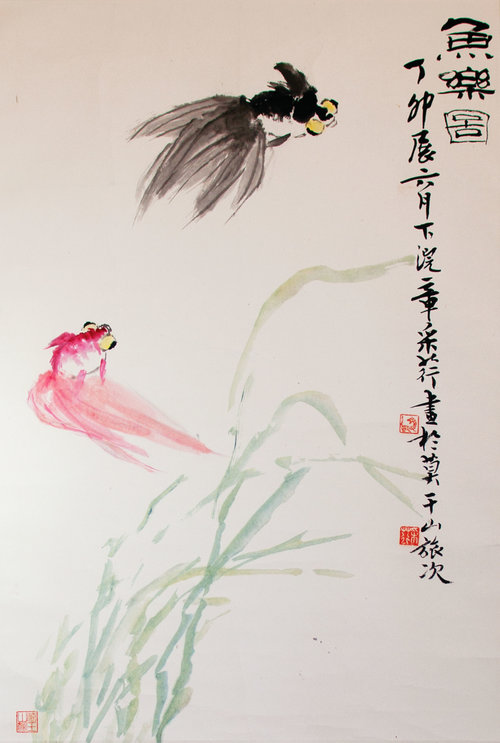
Though the form of the goldfish in Light-hearted isn’t realistic like a Western classical painting, what is true is their spirit and personality — the aim of classical Chinese painting. 
In 1990, Zhang immigrated to Australia with her husband and daughter, excited to get away from the environment now so far removed from the morality her mentors instilled in her.
“The atmosphere in the art field in China was already very bad,” she says. “Artists schemed and fought against each other for fame and profit, but I couldn’t.” The quietude of her new home inspired a peaceful mind and space for painting. But her serenity would soon be smashed, challenging her physically, mentally, spiritually. 
At the young age of 30, Zhang suffered from rheumatoid arthritis, a condition where the immune system attacks the lining of hundreds of joints. 
“It was difficult for me to walk, and I could not sit for long,” says the artist. “I could only lie at home, unable to paint. I felt like I was just living death. My art career started so early but then ended so early.” 
Desperate, struggling, Zhang visited all the famous Chinese and Western doctors in Sydney, but none could help. With a stroke of luck — or a touch of fate, as the case may be — her husband returned home one day with a boon. 
“I still remember when my husband came home that day — he was very excited,” she says. He explained that a new form of qigong — a cultivation system refining morality in combination with tai chi-like exercises — was being taught in town. “I didn’t believe in qigong at that time, but it sounded marvelous.” 

The practice, called Falun Gong, hit home

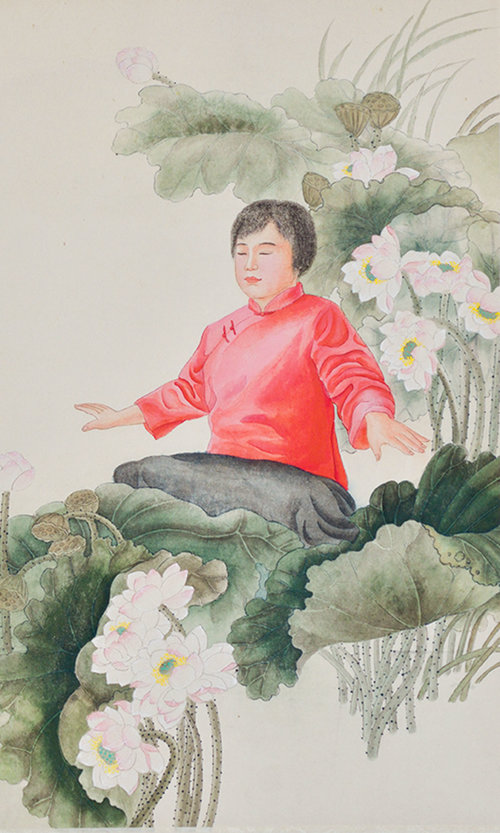
Pure Lotus is Zhang’s self portrait while doing Falun Gong, the spiritual discipline that cured her painful ailment that prohibited her from painting.
“When I listened to the principles, I was immediately attracted,” says the master painter. “I felt many of the principles were like what Mr. Shen taught me, such as to gain, you must suffer losses, and don’t pay much attention to fame and profits. I felt that they were such good principles.”
When she practiced the first exercise, she says, “I felt my occluded vessels were cleared. After I went home, I was even able to sit.”
Nine days later, when the workshop ended, a new chapter in her life began. “I really walked as though I was flying,” Zhang says, her rheumatoid arthritis completely healed. “It was just so miraculous.”
Not only could Zhang paint again, she finally unraveled a deeper essence of art.
“In history, the best works in Chinese painting were called ‘divine works.’ After practicing Falun Gong and following its principles of truthfulness, compassion and tolerance, I could understand the meaning behind those ancient paintings,” she says. She more tangibly experienced that, as artists let go of fame, gain and fortune, their spirits would ascend higher, transforming their perspectives, and consequently, each brushstroke. 
But again, a storm would come that she’d have to weather with every ounce of her will.

More losses, more gains